Brown Engineering

  • Subscribe to our RSS feed.
  • Twitter
  • StumbleUpon
  • Reddit
  • Facebook
  • Digg
Showing posts with label gao. Show all posts

Tuesday, 6 March 2012

Brown Professor Huajian Gao Receives Humboldt Research Award

Posted on 13:17 by Unknown
Huajian Gao, Walter H. Annenberg Professor of Engineering at Brown University, has received a Humboldt Research Award from the Alexander von Humboldt Foundation in Germany. Award winners are invited to spend a period of up to one year cooperating on a long-term research project with specialist colleagues at a research institution in Germany. Professor Dr. Joachim P. Spatz nominated Professor Gao and is hosting him during his research in the Department of Biophysical Chemistry at the University of Heidelberg.

The award is granted in recognition of a researcher's entire achievements to date to academics whose fundamental discoveries, new theories, or insights have had a significant impact on their own discipline and who are expected to continue producing cutting-edge achievements in the future.

“This is a great award for Professor Gao,” said Dean Larry Larson. “He is one of the leading researchers and professors in his field, and that continues to be recognized on both a national and international level. We are fortunate to have him at Brown.”

Professor Gao received his B.S. degree from Xian Jiaotong University of China in 1982, and his M.S. and Ph.D. degrees in engineering science from Harvard University in 1984 and 1988, respectively. He served on the faculty of Stanford University between 1988 and 2002, where he was promoted to associate professor with tenure in 1994 and to full professor in 2000. He was appointed as Director and Professor at the Max Planck Institute for Metals Research in Stuttgart, Germany between 2001 and 2006. He joined Brown University in 2006. Professor Gao has a background in applied mechanics and engineering science. He has more than 25 years of research experience and more than 300 publications to his credit. In February of 2012, he was elected to the National Academy of Engineering (NAE).

Professor Gao’s research group is generally interested in understanding the basic principles that control mechanical properties and behaviors of both engineering and biological systems. His current research includes studies of how metallic and semiconductor materials behave in thin film and nanocrystalline forms, and how biological materials such as bones, geckos, and cells achieve their mechanical robustness through structural hierarchy.
Read More
Posted in gao | No comments

Thursday, 9 February 2012

Brown Professor Huajian Gao Elected to the National Academy of Engineering

Posted on 11:08 by Unknown
Huajian Gao, Walter H. Annenberg Professor of Engineering at Brown University, has been elected to the National Academy of Engineering (NAE). Gao, honored for contributions to micromechanics of thin films and hierarchically structured materials, is one of 66 new members and 10 foreign associates elected, and is one of just 2,254 U.S. members and 206 foreign associates in the NAE.

Election to the National Academy of Engineering is among the highest professional distinctions accorded to an engineer. Academy membership honors those who have made outstanding contributions to "engineering research, practice, or education, including, where appropriate, significant contributions to the engineering literature," and to the "pioneering of new and developing fields of technology, making major advancements in traditional fields of engineering, or developing/implementing innovative approaches to engineering education."

Professor Gao becomes the fifth member of the Brown School of Engineering faculty to be elected to the National Academy of Engineering. He joins Rush C. Hawkins University Professor Rod Clifton (elected 1989), Professor Emeritus L.B. Freund (elected 1994), Professor Emeritus Alan Needleman (elected 2000), and Vice President for Research and Otis Randall University Professor Clyde Briant (elected 2010).

"This is a spectacular professional achievement for Professor Gao and we are extremely happy for him," said Dean Larry Larson. "To have five members of the National Academy within a faculty of 40 also underscores the strength and level of accomplishment of our faculty here at Brown.”

Professor Gao received his B.S. degree from Xian Jiaotong University of China in 1982, and his M.S. and Ph.D. degrees in engineering science from Harvard University in 1984 and 1988, respectively. He served on the faculty of Stanford University between 1988 and 2002, where he was promoted to associate professor with tenure in 1994 and to full professor in 2000. He was appointed as Director and Professor at the Max Planck Institute for Metals Research in Stuttgart, Germany between 2001 and 2006. He joined Brown University in 2006. Professor Gao has a background in applied mechanics and engineering science. He has more than 25 years of research experience and more than 300 publications to his credit.

Professor Gao’s research group is generally interested in understanding the basic principles that control mechanical properties and behaviors of both engineering and biological systems. His current research includes studies of how metallic and semiconductor materials behave in thin film and nanocrystalline forms, and how biological materials such as bones, geckos, and cells achieve their mechanical robustness through structural hierarchy.
Read More
Posted in gao, NAE | No comments

Monday, 19 December 2011

Professor Huajian Gao to Receive Rodney Hill Prize from IUTAM

Posted on 13:01 by Unknown
Huajian Gao, Walter H. Annenberg Professor of Engineering at Brown University, will receive the 2012 Rodney Hill Prize from the International Union of Theoretical and Applied Mechanics (IUTAM). The prize, which consists of a plaque and a check for $25,000, is awarded in recognition of outstanding research in the field of solid mechanics and is awarded only once every four years in conjunction with the International Congress of Theoretical and Applied Mechanics (ICTAM). The initial prize was awarded at ICTAM 2008 in Adelaide, Australia. Professor Gao will receive his award during ICTAM 2012 which will be held in Beijing, China, from August 19-24, 2012.

Professor Gao receives the prize for his deep and broad scientific achievements in basic solid mechanics and its bridge to other fields, which has re-defined the modern frontiers of mechanics research. His work includes fundamental theory as well as applications to materials science, nanotechnology, and bioengineering. His highly cited publications appear not only in the major solid mechanics journals but also in many high-profile, cross-disciplinary journals.


"I want to warmly congratulate Professor Gao on this prestigious and well deserved award," said Dean Larry Larson. "His groundbreaking work shows how the field of solid mechanics - an area of historic national leadership at Brown - can have an impact on fields as diverse as health care, the environment and information technology."

Professor Gao received his B.S. degree from Xian Jiaotong University of China in 1982, and his M.S. and Ph.D. degrees in engineering science from Harvard University in 1984 and 1988, respectively. He served on the faculty of Stanford University between 1988 and 2002, where he was promoted to associate professor with tenure in 1994 and to full professor in 2000. He was appointed as Director and Professor at the Max Planck Institute for Metals Research in Stuttgart, Germany between 2001 and 2006. He joined Brown University in 2006. Professor Gao has a background in applied mechanics and engineering science. He has more than 25 years of research experience and more than 300 publications to his credit.

Professor Gao’s research group is generally interested in understanding the basic principles that control mechanical properties and behaviors of both engineering and biological systems. His current research includes studies of how metallic and semiconductor materials behave in thin film and nanocrystalline forms, and how biological materials such as bones, geckos, and cells achieve their mechanical robustness through structural hierarchy.

About IUTAM and its Congress
The International Union of Theoretical and Applied Mechanics (IUTAM) is an international non-governmental scientific organization belonging to the International Council of Scientific Unions (ICSU), which was formed in 1946 and founded in 1948, with the objectives to form a link between persons and organizations engaged in scientific work in mechanics and related fields, and to promote the development of mechanics, both theoretical and applied, as a scientific discipline.

IUTAM achieves this aim mainly by organizing international meetings to deal with scientific problems. An International Congress on Theoretical and Applied Mechanics (ICTAM), including mini-symposia and pre-nominated sessions, is held every four years. It is organized by the Congress Committee, established by the IUTAM General Assembly.
Read More
Posted in award, gao | No comments

Tuesday, 20 September 2011

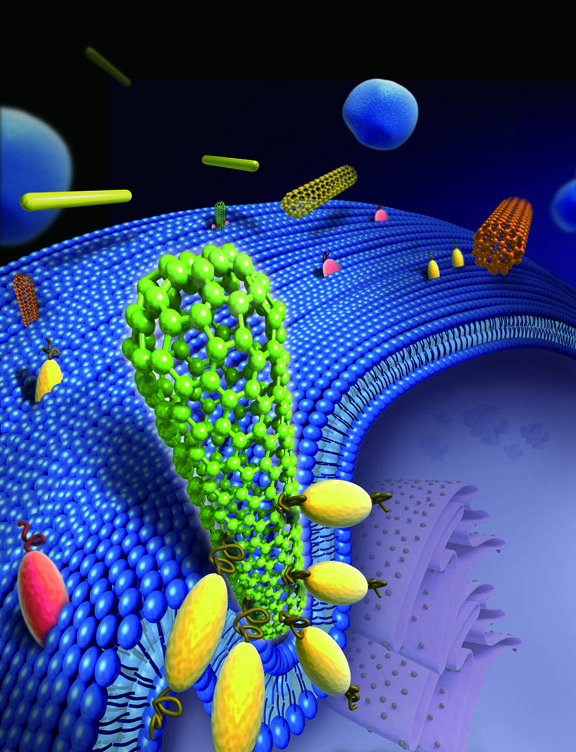
Why carbon nanotubes spell trouble for cells

Posted on 07:17 by Unknown
Carbon nanotubes and other long nanomaterials can spell trouble for cells. The reason: Cells mistake them for spheres and try to engulf them. Once they start, cells cannot reverse course, and complete ingestion never occurs. Researchers at Brown University detail for the first time how cells interact with carbon nanotubes, gold nanowires and asbestos fibers. Results are published in Nature Nanotechnology.

PROVIDENCE, R.I.
[Brown University] — It’s been long known that asbestos spells trouble for human cells. Scientists have seen cells stabbed with spiky, long asbestos fibers, and the image is gory: Part of the fiber is protruding from the cell, like a quivering arrow that’s found its mark.


Something perpendicular this way comesCells ingest things by engulfing them. When a long
perpendicular fiber comes near, the cell senses
only its tip, mistakes it for a sphere, and begins
engulfing something too long to handle.
Credit: Gao Lab/Brown University
But scientists had been unable to understand why cells would be interested in asbestos fibers and other materials at the nanoscale that are too long to be fully ingested. Now a group of researchers at Brown University explains what happens. Through molecular simulations and experiments, the team reports in Nature Nanotechnology that certain nanomaterials, such as carbon nanotubes, enter cells tip-first and almost always at a 90-degree angle. The orientation ends up fooling the cell; by taking in the rounded tip first, the cell mistakes the particle for a sphere, rather than a long cylinder. By the time the cell realizes the material is too long to be fully ingested, it’s too late.

“It’s as if we would eat a lollipop that’s longer than us,” said Huajian Gao, professor of engineering at Brown and the paper’s corresponding author. “It would get stuck.”
The research is important because nanomaterials like carbon nanotubes have promise in medicine, such as acting as vehicles to transport drugs to specific cells or to specific locations in the human body. If scientists can fully understand how nanomaterials interact with cells, then they can conceivably design products that help cells rather than harm them.
“If we can fully understand (nanomaterial-cell dynamics), we can make other tubes that can control how cells interact with nanomaterials and not be toxic,” Gao said. “We ultimately want to stop the attraction between the nanotip and the cell.”

Misrecognition
Receptors on the cell’s surface crowd around the nanotube, effectively standing it upright. The cell mistakes the tube for a sphere and begins to engulf it.
 Credit: Gao Lab/Brown University

Like asbestos fibers, commercially available carbon nanotubes and gold nanowires have rounded tips that often range from 10 to 100 nanometers in diameter. Size is important here; the diameter fits well within the cell’s parameters for what it can handle. Brushing up against the nanotube, special proteins called receptors on the cell spring into action, clustering and bending the membrane wall to wrap the cell around the nanotube tip in a sequence that the authors call “tip recognition.” As this occurs, the nanotube is tipped to a 90-degree angle, which reduces the amount of energy needed for the cell to engulf the particle.
Once the engulfing — endocytosis — begins, there is no turning back. Within minutes, the cell senses it can’t fully engulf the nanostructure and essentially dials 911. “At this stage, it’s too late,” Gao said. “It’s in trouble and calls for help, triggering an immune response that can cause repeated inflammation.”
The team hypothesized the interaction using coarse-grained molecular dynamic simulations and capped multiwalled carbon nanotubes. In experiments involving nanotubes and gold nanowires and mouse liver cells and human mesothelial cells, the nanomaterials entered the cells tip-first and at a 90-degree angle about 90 percent of the time, the researchers report.
“We thought the tube was going to lie on the cell membrane to obtain more binding sites. However, our simulations revealed the tube steadily rotating to a high-entry degree, with its tip being fully wrapped,” said Xinghua Shi, first author on the paper who earned his doctorate at Brown and is at the Chinese Academy of Sciences in Beijing. “It is counter-intuitive and is mainly due to the bending energy release as the membrane is wrapping the tube.”
The team would like to study whether nanotubes without rounded tips — or less rigid nanomaterials such as nanoribbons — pose the same dilemma for cells.
“Interestingly, if the rounded tip of a carbon nanotube is cut off (meaning the tube is open and hollow), the tube lies on the cell membrane, instead of entering the cell at a high-degree-angle," Shi said.
Agnes Kane, professor of pathology and laboratory medicine at Brown, is a corresponding author on the paper. Other authors include Annette von dem Bussche from the Department of Pathology and Laboratory Medicine at Brown and Robert Hurt from the Institute for Molecular and Nanoscale Innovation at Brown.
The National Science Foundation, the U.S. Department of Commerce National Institute of Standards and Technology, the National Institute of Environmental Health Sciences Superfund Research Program, and the American Recovery and Reinvestment Act funded the research.
By Richard Lewis
Read More
Posted in gao, nano, nanotubes | No comments

Thursday, 8 April 2010

Gao and his research team discovers new principle in Material Science

Posted on 10:25 by Unknown
A research team led by Brown University engineers has discovered a new mechanism that governs the peak strength of nanostructured metals. The team found that the deformation of nanotwinned metals is characterized by the motion of highly ordered, necklace-like patterns of crystal defects called dislocations. The finding, published in Nature, could lead to stronger and more ductile metals.

Full press release here:
http://news.brown.edu/pressreleases/2010/04/nanotwins
Read More
Posted in gao, research | No comments

Tuesday, 5 May 2009

Gao receives award

Posted on 07:45 by Unknown
Huajian Gao has been selected to receive the 2009 Robert Henry Thurston Lecture Award from the American Society of Mechanical Engineers “for groundbreaking research on mechanical properties of both engineering and biological systems across multiple length scales”. Formal presentation of the award is scheduled to take place at the Robert Henry Thurston Lecture, during the ASME International Mechanical Engineering Congress & Exposition, November 13-19, 2009.

About the Robert Henry Thurston Lecture Award:

The Robert Henry Thurston Lecture was established in 1925 in honor of Robert Henry Thurston (Brown, B.S., Civil Engineering, 1859), the first president of ASME and a farseeing leader in science and engineering. The Robert Henry Thurston Lecture, presented annually at the International Mechanical Engineering Congress, provides an outstanding leader in pure or applied science or engineering with the honor of presenting to the Society a lecture that encourages stimulating thinking on a subject of broad technical interest to engineers. The Robert Henry Thurston Lecture was elevated to a Society award in 2000.

Robert Henry Thurston (1839-1903) was born in Providence, Rhode Island. His father, Robert Lawton Thurston, manufactured steam engines in Providence. The young Robert Henry Thurston went to Brown University, where he graduated as a civil engineer in 1859. He was the first professor of mechanical engineering at Stevens Institute of Technology (in 1871). There he established Stevens’ mechanical engineering curriculum. Historians credit Thurston with establishing the first US mechanical engineering laboratory for conducting funded research at an academic institution for higher learning. He was the first president (1880-82) of the American Society of Mechanical Engineers.
Read More
Posted in award, gao | No comments
Older Posts Home
Subscribe to: Posts (Atom)

Popular Posts

  • Clyde Briant elected to the National Academy of Engineering
    Congratulations to Clyde Briant on his election to the National Academy of Engineering. Election to the National Academy of Engineering is ...
  • Nanoparticles eliminate bacterial infection on prosthetic
    Infected implants now have a foe. Brown University researchers have created a nanoparticle that can penetrate a bacterial-produced film on p...
  • Hydrodynamics of Microorganisms
    Professor Powers' article, Hydrodynamics of Swimming Mircoorganisms, was accepted this week in Reports on Progress in Physics. Preview t...
  • AIChE Prize Winners
    This year, in celebration of AIChE's centennial, the AIChE Annual Meeting featured special sessions that highlight chemical engineering...
  • RI Woman of the Year
    The Rhode Island Commission on Women (RICW) is pleased to announce the 2009 Women of the Year, Lynn Ewart-Paine, ’85 ’86 Sc.M. ’90 Ph.D., S...
  • Nanosatellite Launch Vehicle Conference
    In the over 25 years since small, low cost space began its transition from curiosity to the integral element of world-wide civil and militar...
  • NanoVis, Inc earns 2nd in Venture Idol
    NanoVis, Inc., a Brown start-up company, Gets 2nd Place in Venture Idol Competition NanoVis, Inc., a Brown start-up company was awarded 2nd ...
  • Superfund renewed to create a safer and healthier RI
    Brown's Superfund Research Program (SRP) brings together researchers from engineering, biology and medicine, geological sciences, and so...
  • IGEM Jamboree
    The 2008 Brown iGEM Teams worked on two projects--one a toxin detection & electrical reporting system using E. Coli bacteria and the se...
  • Wei Yang to lead China’s National Natural Sciences Foundation
    Wei Yang Ph.D.’85 Sc.D.’12 hon., an internationally celebrated engineer and materials science researcher, educator, and administrator, has ...

Categories

  • "Sirinrath Sirivisoot"
  • aaas
  • aaron
  • abet
  • accreditation
  • aceros
  • ACS
  • admission
  • admissions
  • advanced baby imaging lab
  • AIChE
  • AIChE ugrad award
  • AIMBE
  • almeida
  • alumni
  • Andrew Peterson
  • apoE4
  • archaeology
  • archambault
  • argyria
  • ARPA-E
  • article
  • artificial ovary
  • asme
  • associate dean
  • audax
  • audio
  • awar
  • award
  • axena
  • Aziz
  • Baek
  • bahar computer conference
  • banyan
  • bashevkin
  • bats
  • battery
  • beam
  • BEAR Day
  • bio
  • biodiesel
  • biofilm
  • biofuel
  • blume
  • bme
  • bmes
  • book
  • borton
  • bower
  • brain initiative
  • Brain Science
  • brain sensor
  • brain-computer interface
  • braingate
  • braingate2
  • breuer
  • breuer bats reuters
  • briant
  • brown institute of brain science
  • bull
  • bull risd car
  • business plan
  • calakli
  • calo
  • CAMR
  • car
  • carbon
  • career fair
  • Caswell
  • catena
  • cave
  • CfNN
  • chemical innovation program
  • China
  • civil engineering
  • coda
  • coe-sullivan
  • collaboration
  • commencement
  • competition
  • Computational Materials Science
  • concussion
  • cooper
  • cord-clamping
  • crisco
  • crisco risd
  • CRL
  • Curet
  • curtin
  • cyberkinetics
  • dang
  • dean
  • decker
  • deisley
  • deoni
  • desai
  • desktop delta-v
  • dingman
  • DOE
  • donoghue
  • donovan
  • Durmus
  • dworak
  • eastman conference
  • ejiofor
  • election
  • elevator pitch
  • emanuel
  • emotive
  • Empower
  • en4
  • energy-momentum spectroscopy
  • ENGN 1930G
  • entrepreneurship
  • Entreprenuership
  • EPSCOR
  • escuti
  • event
  • ewb
  • faculty
  • feature
  • fellowship
  • Felzenszwalb
  • fleeter
  • fluid dynamics
  • franck
  • freund
  • fsae
  • fulbright
  • gao
  • General Motors
  • GhostBot
  • gidmark
  • gingerbread
  • GM
  • GM/Brown
  • grad
  • graduate
  • grant
  • grantab
  • graphene
  • greis
  • guduru
  • guo
  • haberstroh
  • halpin
  • halpin prize
  • Hargus
  • hazeltine
  • heart
  • hibbitt
  • HnC
  • hochberg
  • huebscher
  • hurt
  • hurt cfl nyt
  • hydrokinetic
  • IE
  • IIT-Bombay
  • IMNI
  • implant
  • Indo-US
  • innovation
  • institute of medicine
  • international
  • internship
  • jackson
  • jadhav
  • jakubek
  • Jay
  • JCD Wind
  • jepsen
  • joukowsky
  • JPL
  • kane
  • kesari
  • keynote
  • Kim
  • klout
  • Kristie Chin
  • kulaots
  • Külaots
  • kumar
  • Kummer
  • lacrosse
  • larson
  • laser
  • laulicht
  • lavernia
  • Lazos
  • Lee
  • LEGO
  • LIB
  • light emission
  • liquid bone
  • lithium ion battery
  • Liu Finalist GEMS Award
  • lubricin
  • lysaght
  • magnet
  • malik
  • Mandre
  • maris
  • materials
  • Materials Research
  • mathiowitz
  • mba
  • mccalla
  • Mechanics
  • Megan Buczynski
  • mentor
  • mercury
  • metamaterials
  • metaphotonics
  • MGI
  • mittlemann
  • morgan
  • muri
  • NAE
  • nano
  • nanoparticles
  • nanopatch
  • nanoscience
  • nanoskin
  • nanotechnology
  • nanotubes
  • nanovis
  • NASA
  • Needleman
  • neuroengineering
  • Neurorestoration
  • Neuroscience
  • neurotechnology
  • NewMech
  • NewMech2012
  • nih
  • nsf
  • NSFC
  • nurmikko
  • nurse
  • open house
  • optical
  • osteoarthritis
  • overhead.fm
  • pacifici
  • padture
  • palmore
  • palmore hoffmankim nih
  • paper
  • patent
  • paxson
  • pecase
  • Peterson
  • petteruti
  • Phi Beta Kappa
  • photos graduation
  • powers
  • powers editor journal
  • president
  • prime
  • PRIME Omega-3
  • Privicare
  • PriWater
  • profiles
  • project
  • publication
  • publication leadership
  • qd vision
  • Raimondo
  • rainwater
  • ramesh
  • Ramos
  • rankings
  • reda
  • reed
  • Reggiannini
  • research
  • richardson
  • risd
  • Riviere
  • robot
  • robots
  • rome
  • rosakis
  • Rosenstein
  • Runa
  • salomon award
  • sarin
  • schutter
  • scripta materialia
  • selenium
  • SES
  • sharp
  • sheldon
  • shenoy
  • sigma xi
  • silver
  • Silverman
  • simeral
  • simulia
  • SMART
  • solar
  • Solar4Cents
  • space
  • Speramus
  • Spira
  • stac
  • startup
  • stem outreach
  • Stout
  • summer
  • superfund
  • suuberg
  • swe
  • sygiel
  • takamoto biogas
  • tau beta pi
  • taubin
  • taylor
  • team
  • timoshenko
  • tissue
  • tissue engineering
  • tran
  • tripathi
  • tsang
  • twitter
  • ugrad
  • VA
  • van de Walle
  • venture for america
  • video
  • Vlahovska
  • wadia
  • wang
  • warshay
  • watson
  • website
  • webster
  • webster nano
  • webster nurmikko bio conference
  • Wells
  • weng
  • wireless
  • workshop
  • yang
  • yin
  • zhang
  • zhang webster star award phd
  • zia
  • zia nsf award

Blog Archive

  • ▼  2013 (18)
    • ▼  April (1)
      • Nurmikko and Donoghue join U.S. BRAIN initiative
    • ►  March (5)
    • ►  February (4)
    • ►  January (8)
  • ►  2012 (76)
    • ►  December (5)
    • ►  November (8)
    • ►  October (9)
    • ►  September (5)
    • ►  August (6)
    • ►  July (6)
    • ►  June (5)
    • ►  May (4)
    • ►  April (8)
    • ►  March (11)
    • ►  February (6)
    • ►  January (3)
  • ►  2011 (95)
    • ►  December (7)
    • ►  November (9)
    • ►  October (8)
    • ►  September (11)
    • ►  August (8)
    • ►  July (4)
    • ►  June (3)
    • ►  May (10)
    • ►  April (7)
    • ►  March (10)
    • ►  February (10)
    • ►  January (8)
  • ►  2010 (55)
    • ►  December (13)
    • ►  November (8)
    • ►  October (3)
    • ►  September (2)
    • ►  August (5)
    • ►  July (1)
    • ►  June (2)
    • ►  May (8)
    • ►  April (5)
    • ►  March (2)
    • ►  February (4)
    • ►  January (2)
  • ►  2009 (46)
    • ►  December (7)
    • ►  November (2)
    • ►  October (4)
    • ►  September (4)
    • ►  August (2)
    • ►  July (5)
    • ►  June (4)
    • ►  May (6)
    • ►  April (5)
    • ►  March (1)
    • ►  February (4)
    • ►  January (2)
  • ►  2008 (15)
    • ►  December (1)
    • ►  November (4)
    • ►  October (1)
    • ►  September (1)
    • ►  August (2)
    • ►  July (3)
    • ►  June (2)
    • ►  April (1)
  • ►  2007 (1)
    • ►  February (1)
Powered by Blogger.

About Me

Unknown
View my complete profile