Brown Engineering

  • Subscribe to our RSS feed.
  • Twitter
  • StumbleUpon
  • Reddit
  • Facebook
  • Digg

Tuesday, 20 September 2011

Why carbon nanotubes spell trouble for cells

Posted on 07:17 by Unknown
Carbon nanotubes and other long nanomaterials can spell trouble for cells. The reason: Cells mistake them for spheres and try to engulf them. Once they start, cells cannot reverse course, and complete ingestion never occurs. Researchers at Brown University detail for the first time how cells interact with carbon nanotubes, gold nanowires and asbestos fibers. Results are published in Nature Nanotechnology.

PROVIDENCE, R.I.
[Brown University] — It’s been long known that asbestos spells trouble for human cells. Scientists have seen cells stabbed with spiky, long asbestos fibers, and the image is gory: Part of the fiber is protruding from the cell, like a quivering arrow that’s found its mark.
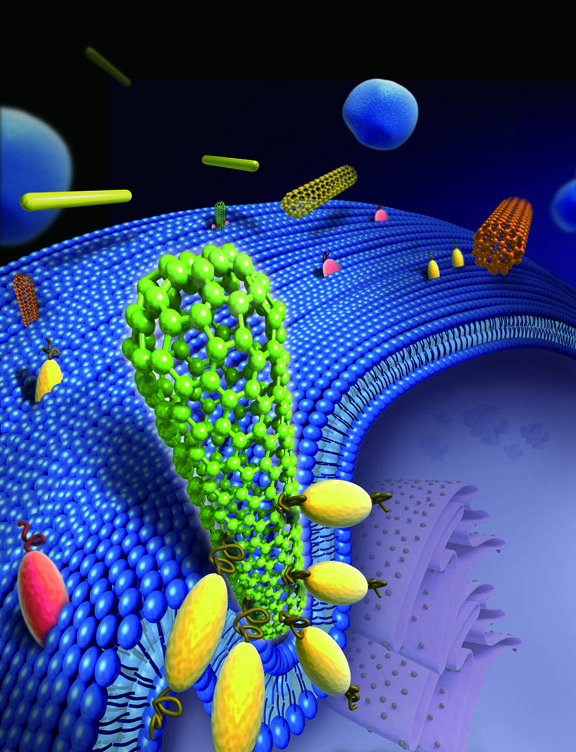

Something perpendicular this way comesCells ingest things by engulfing them. When a long
perpendicular fiber comes near, the cell senses
only its tip, mistakes it for a sphere, and begins
engulfing something too long to handle.
Credit: Gao Lab/Brown University
But scientists had been unable to understand why cells would be interested in asbestos fibers and other materials at the nanoscale that are too long to be fully ingested. Now a group of researchers at Brown University explains what happens. Through molecular simulations and experiments, the team reports in Nature Nanotechnology that certain nanomaterials, such as carbon nanotubes, enter cells tip-first and almost always at a 90-degree angle. The orientation ends up fooling the cell; by taking in the rounded tip first, the cell mistakes the particle for a sphere, rather than a long cylinder. By the time the cell realizes the material is too long to be fully ingested, it’s too late.

“It’s as if we would eat a lollipop that’s longer than us,” said Huajian Gao, professor of engineering at Brown and the paper’s corresponding author. “It would get stuck.”
The research is important because nanomaterials like carbon nanotubes have promise in medicine, such as acting as vehicles to transport drugs to specific cells or to specific locations in the human body. If scientists can fully understand how nanomaterials interact with cells, then they can conceivably design products that help cells rather than harm them.
“If we can fully understand (nanomaterial-cell dynamics), we can make other tubes that can control how cells interact with nanomaterials and not be toxic,” Gao said. “We ultimately want to stop the attraction between the nanotip and the cell.”

Misrecognition
Receptors on the cell’s surface crowd around the nanotube, effectively standing it upright. The cell mistakes the tube for a sphere and begins to engulf it.
 Credit: Gao Lab/Brown University

Like asbestos fibers, commercially available carbon nanotubes and gold nanowires have rounded tips that often range from 10 to 100 nanometers in diameter. Size is important here; the diameter fits well within the cell’s parameters for what it can handle. Brushing up against the nanotube, special proteins called receptors on the cell spring into action, clustering and bending the membrane wall to wrap the cell around the nanotube tip in a sequence that the authors call “tip recognition.” As this occurs, the nanotube is tipped to a 90-degree angle, which reduces the amount of energy needed for the cell to engulf the particle.
Once the engulfing — endocytosis — begins, there is no turning back. Within minutes, the cell senses it can’t fully engulf the nanostructure and essentially dials 911. “At this stage, it’s too late,” Gao said. “It’s in trouble and calls for help, triggering an immune response that can cause repeated inflammation.”
The team hypothesized the interaction using coarse-grained molecular dynamic simulations and capped multiwalled carbon nanotubes. In experiments involving nanotubes and gold nanowires and mouse liver cells and human mesothelial cells, the nanomaterials entered the cells tip-first and at a 90-degree angle about 90 percent of the time, the researchers report.
“We thought the tube was going to lie on the cell membrane to obtain more binding sites. However, our simulations revealed the tube steadily rotating to a high-entry degree, with its tip being fully wrapped,” said Xinghua Shi, first author on the paper who earned his doctorate at Brown and is at the Chinese Academy of Sciences in Beijing. “It is counter-intuitive and is mainly due to the bending energy release as the membrane is wrapping the tube.”
The team would like to study whether nanotubes without rounded tips — or less rigid nanomaterials such as nanoribbons — pose the same dilemma for cells.
“Interestingly, if the rounded tip of a carbon nanotube is cut off (meaning the tube is open and hollow), the tube lies on the cell membrane, instead of entering the cell at a high-degree-angle," Shi said.
Agnes Kane, professor of pathology and laboratory medicine at Brown, is a corresponding author on the paper. Other authors include Annette von dem Bussche from the Department of Pathology and Laboratory Medicine at Brown and Robert Hurt from the Institute for Molecular and Nanoscale Innovation at Brown.
The National Science Foundation, the U.S. Department of Commerce National Institute of Standards and Technology, the National Institute of Environmental Health Sciences Superfund Research Program, and the American Recovery and Reinvestment Act funded the research.
By Richard Lewis
Email ThisBlogThis!Share to XShare to FacebookShare to Pinterest
Posted in gao, nano, nanotubes | No comments
Newer Post Older Post Home

0 comments:

Post a Comment

Subscribe to: Post Comments (Atom)

Popular Posts

  • Nanoparticles eliminate bacterial infection on prosthetic
    Infected implants now have a foe. Brown University researchers have created a nanoparticle that can penetrate a bacterial-produced film on p...
  • AIChE Prize Winners
    This year, in celebration of AIChE's centennial, the AIChE Annual Meeting featured special sessions that highlight chemical engineering...
  • Nanosatellite Launch Vehicle Conference
    In the over 25 years since small, low cost space began its transition from curiosity to the integral element of world-wide civil and militar...
  • RI Woman of the Year
    The Rhode Island Commission on Women (RICW) is pleased to announce the 2009 Women of the Year, Lynn Ewart-Paine, ’85 ’86 Sc.M. ’90 Ph.D., S...
  • Superfund renewed to create a safer and healthier RI
    Brown's Superfund Research Program (SRP) brings together researchers from engineering, biology and medicine, geological sciences, and so...
  • NanoVis, Inc earns 2nd in Venture Idol
    NanoVis, Inc., a Brown start-up company, Gets 2nd Place in Venture Idol Competition NanoVis, Inc., a Brown start-up company was awarded 2nd ...
  • IGEM Jamboree
    The 2008 Brown iGEM Teams worked on two projects--one a toxin detection & electrical reporting system using E. Coli bacteria and the se...
  • Hydrodynamics of Microorganisms
    Professor Powers' article, Hydrodynamics of Swimming Mircoorganisms, was accepted this week in Reports on Progress in Physics. Preview t...
  • Wei Yang to lead China’s National Natural Sciences Foundation
    Wei Yang Ph.D.’85 Sc.D.’12 hon., an internationally celebrated engineer and materials science researcher, educator, and administrator, has ...
  • Indo-US Science and Technology Forum collaborates with Brown
    Created in March 2000, the Indo-US Science and Technology Forum (IUSSTF), established under an agreement between the Governments of India an...

Categories

  • "Sirinrath Sirivisoot"
  • aaas
  • aaron
  • abet
  • accreditation
  • aceros
  • ACS
  • admission
  • admissions
  • advanced baby imaging lab
  • AIChE
  • AIChE ugrad award
  • AIMBE
  • almeida
  • alumni
  • Andrew Peterson
  • apoE4
  • archaeology
  • archambault
  • argyria
  • ARPA-E
  • article
  • artificial ovary
  • asme
  • associate dean
  • audax
  • audio
  • awar
  • award
  • axena
  • Aziz
  • Baek
  • bahar computer conference
  • banyan
  • bashevkin
  • bats
  • battery
  • beam
  • BEAR Day
  • bio
  • biodiesel
  • biofilm
  • biofuel
  • blume
  • bme
  • bmes
  • book
  • borton
  • bower
  • brain initiative
  • Brain Science
  • brain sensor
  • brain-computer interface
  • braingate
  • braingate2
  • breuer
  • breuer bats reuters
  • briant
  • brown institute of brain science
  • bull
  • bull risd car
  • business plan
  • calakli
  • calo
  • CAMR
  • car
  • carbon
  • career fair
  • Caswell
  • catena
  • cave
  • CfNN
  • chemical innovation program
  • China
  • civil engineering
  • coda
  • coe-sullivan
  • collaboration
  • commencement
  • competition
  • Computational Materials Science
  • concussion
  • cooper
  • cord-clamping
  • crisco
  • crisco risd
  • CRL
  • Curet
  • curtin
  • cyberkinetics
  • dang
  • dean
  • decker
  • deisley
  • deoni
  • desai
  • desktop delta-v
  • dingman
  • DOE
  • donoghue
  • donovan
  • Durmus
  • dworak
  • eastman conference
  • ejiofor
  • election
  • elevator pitch
  • emanuel
  • emotive
  • Empower
  • en4
  • energy-momentum spectroscopy
  • ENGN 1930G
  • entrepreneurship
  • Entreprenuership
  • EPSCOR
  • escuti
  • event
  • ewb
  • faculty
  • feature
  • fellowship
  • Felzenszwalb
  • fleeter
  • fluid dynamics
  • franck
  • freund
  • fsae
  • fulbright
  • gao
  • General Motors
  • GhostBot
  • gidmark
  • gingerbread
  • GM
  • GM/Brown
  • grad
  • graduate
  • grant
  • grantab
  • graphene
  • greis
  • guduru
  • guo
  • haberstroh
  • halpin
  • halpin prize
  • Hargus
  • hazeltine
  • heart
  • hibbitt
  • HnC
  • hochberg
  • huebscher
  • hurt
  • hurt cfl nyt
  • hydrokinetic
  • IE
  • IIT-Bombay
  • IMNI
  • implant
  • Indo-US
  • innovation
  • institute of medicine
  • international
  • internship
  • jackson
  • jadhav
  • jakubek
  • Jay
  • JCD Wind
  • jepsen
  • joukowsky
  • JPL
  • kane
  • kesari
  • keynote
  • Kim
  • klout
  • Kristie Chin
  • kulaots
  • Külaots
  • kumar
  • Kummer
  • lacrosse
  • larson
  • laser
  • laulicht
  • lavernia
  • Lazos
  • Lee
  • LEGO
  • LIB
  • light emission
  • liquid bone
  • lithium ion battery
  • Liu Finalist GEMS Award
  • lubricin
  • lysaght
  • magnet
  • malik
  • Mandre
  • maris
  • materials
  • Materials Research
  • mathiowitz
  • mba
  • mccalla
  • Mechanics
  • Megan Buczynski
  • mentor
  • mercury
  • metamaterials
  • metaphotonics
  • MGI
  • mittlemann
  • morgan
  • muri
  • NAE
  • nano
  • nanoparticles
  • nanopatch
  • nanoscience
  • nanoskin
  • nanotechnology
  • nanotubes
  • nanovis
  • NASA
  • Needleman
  • neuroengineering
  • Neurorestoration
  • Neuroscience
  • neurotechnology
  • NewMech
  • NewMech2012
  • nih
  • nsf
  • NSFC
  • nurmikko
  • nurse
  • open house
  • optical
  • osteoarthritis
  • overhead.fm
  • pacifici
  • padture
  • palmore
  • palmore hoffmankim nih
  • paper
  • patent
  • paxson
  • pecase
  • Peterson
  • petteruti
  • Phi Beta Kappa
  • photos graduation
  • powers
  • powers editor journal
  • president
  • prime
  • PRIME Omega-3
  • Privicare
  • PriWater
  • profiles
  • project
  • publication
  • publication leadership
  • qd vision
  • Raimondo
  • rainwater
  • ramesh
  • Ramos
  • rankings
  • reda
  • reed
  • Reggiannini
  • research
  • richardson
  • risd
  • Riviere
  • robot
  • robots
  • rome
  • rosakis
  • Rosenstein
  • Runa
  • salomon award
  • sarin
  • schutter
  • scripta materialia
  • selenium
  • SES
  • sharp
  • sheldon
  • shenoy
  • sigma xi
  • silver
  • Silverman
  • simeral
  • simulia
  • SMART
  • solar
  • Solar4Cents
  • space
  • Speramus
  • Spira
  • stac
  • startup
  • stem outreach
  • Stout
  • summer
  • superfund
  • suuberg
  • swe
  • sygiel
  • takamoto biogas
  • tau beta pi
  • taubin
  • taylor
  • team
  • timoshenko
  • tissue
  • tissue engineering
  • tran
  • tripathi
  • tsang
  • twitter
  • ugrad
  • VA
  • van de Walle
  • venture for america
  • video
  • Vlahovska
  • wadia
  • wang
  • warshay
  • watson
  • website
  • webster
  • webster nano
  • webster nurmikko bio conference
  • Wells
  • weng
  • wireless
  • workshop
  • yang
  • yin
  • zhang
  • zhang webster star award phd
  • zia
  • zia nsf award

Blog Archive

  • ►  2013 (18)
    • ►  April (1)
    • ►  March (5)
    • ►  February (4)
    • ►  January (8)
  • ►  2012 (76)
    • ►  December (5)
    • ►  November (8)
    • ►  October (9)
    • ►  September (5)
    • ►  August (6)
    • ►  July (6)
    • ►  June (5)
    • ►  May (4)
    • ►  April (8)
    • ►  March (11)
    • ►  February (6)
    • ►  January (3)
  • ▼  2011 (95)
    • ►  December (7)
    • ►  November (9)
    • ►  October (8)
    • ▼  September (11)
      • Brain researchers study high-tech ways to overcome...
      • Why carbon nanotubes spell trouble for cells
      • Dean Larry Larson featured in Providence Business ...
      • Bioengineering Professor Leads Research on Head Im...
      • Brown’s Lei Yang ScM ’11 PhD ’11 Named a Sigma Xi ...
      • Meet the Faculty: Andrew Peterson
      • Meet the Faculty: Pedro Felzenszwalb
      • Meet the Faculty: Axel van de Walle
      • Meet the Faculty: Nitin Padture
      • Meet the Faculty: Lawrence Larson
      • Brown School of Engineering to Host Open House for...
    • ►  August (8)
    • ►  July (4)
    • ►  June (3)
    • ►  May (10)
    • ►  April (7)
    • ►  March (10)
    • ►  February (10)
    • ►  January (8)
  • ►  2010 (55)
    • ►  December (13)
    • ►  November (8)
    • ►  October (3)
    • ►  September (2)
    • ►  August (5)
    • ►  July (1)
    • ►  June (2)
    • ►  May (8)
    • ►  April (5)
    • ►  March (2)
    • ►  February (4)
    • ►  January (2)
  • ►  2009 (46)
    • ►  December (7)
    • ►  November (2)
    • ►  October (4)
    • ►  September (4)
    • ►  August (2)
    • ►  July (5)
    • ►  June (4)
    • ►  May (6)
    • ►  April (5)
    • ►  March (1)
    • ►  February (4)
    • ►  January (2)
  • ►  2008 (15)
    • ►  December (1)
    • ►  November (4)
    • ►  October (1)
    • ►  September (1)
    • ►  August (2)
    • ►  July (3)
    • ►  June (2)
    • ►  April (1)
  • ►  2007 (1)
    • ►  February (1)
Powered by Blogger.

About Me

Unknown
View my complete profile